
Points Allocation Survey Method [Explanation & Real Examples]
“Points allocation gives each participant a fixed budget of points to spread across a list of options. Unlike a ranking, it captures how strongly people feel about each option, not only the order they put them in. This guide covers what the format is, when it beats an implicit method like pairwise comparison, three research questions it suits, and which survey platforms actually offer it.”
Contents:
What is a points allocation survey question?
What does it look like in a real research project?
When is it the right question to use?
What research questions does it suit?
Which survey platforms offer this question type?
What is a points allocation survey question?
Points allocation, also known as constant sum, is a survey method where participants allocate a budget of points across a set of options according to their personal preferences.

It ranks a list and shows the magnitude of people's preferences, not only their order. Simon puts 9 of his 10 points on apples, which is a sharper piece of information than knowing he prefers them to bananas.
What does it look like in a real research project?
This method played a role in the early success of Google Docs.
While Google Docs was still in beta, the team worked with pilot users to improve the experience before public launch. The product was rough, so the team collected feedback on which parts needed work most. Suggestions came out of informal interviews and testing sessions, and the tally produced a long list of requested features with no clear priority, which left the team unsure where to focus.
Then a product manager asked beta users a different question: if you had $100 to spend on improving Google Docs, how would you spend it across this list of problems?
The answer was unambiguous. Beta testers put the overwhelming majority of their points on document formatting.

^ Google Docs, October 2006 (lacking a lot of formatting…)
The team took that into user interviews and asked testers to explain the formatting problems in detail. What they found was that minor text changes could destroy a document's entire format, costing users hours of work to repair. It was bad enough that beta testers were abandoning Google Docs over it.
The underlying lesson holds regardless. Asking users to suggest problems is unreliable, because it depends on them recalling the right problem at the exact moment you ask, and people are bad at that. Counting a tally of feature requests measures how often something came to mind; a points budget measures how much it actually costs them.
When is it the right question to use?
The distinction is implicit against explicit preference.
Pairwise comparison reads implicit preferences. It ranks by asking people to vote on a series of head-to-head pairs, which shows what matters to them without anyone having to state it directly.
A points budget asks for explicit preferences. People say what matters and how much, in one action.
Implicit formats work better when the subconscious is doing the deciding. Ranking a list of possible names for a new product is a good example, because comparing a dozen names rationally at once is close to impossible.
Where the decision is a rational one the participant can reason through, an explicit format fits better. Ranking which features in a paid subscription plan drive the most value is a good example.
What research questions does it suit?
Three examples.
1. Customer preferences
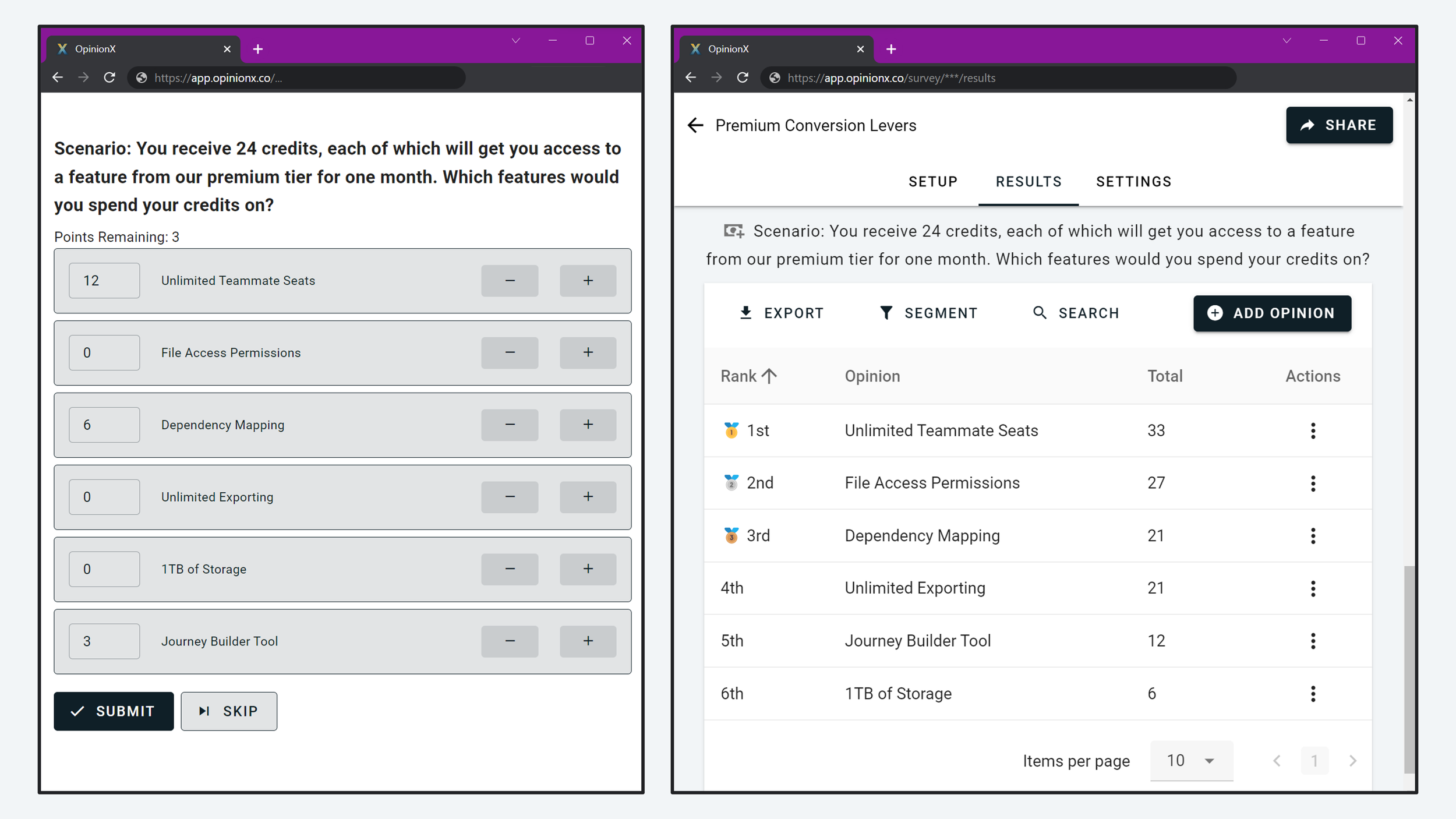
As in the Google Docs case, the format captures the magnitude of preference. If you're deciding between a range of options, like which features most push freemium users towards a paid subscription, it will usually tell you more than a pure comparison format.
2. Value association
Imagine you run a business bundling several services into one price. You're a graduation photographer charging $50 to edit the photos, mail physical prints and share digital copies. You're considering splitting those into separate products at higher prices, and you don't know which ones customers value most.
Give participants $50 in imaginary points and ask them to divide it by how much they would expect to pay for each service separately. What comes back is perceived value, priced.

3. Time breakdowns
Casey Neistat's 2015 YouTube video "Fat and Lazy" broke his average day into 24 one-hour slots to show viewers where his time went.
You can run the same exercise with research participants. Take the number of hours in a typical working week, give each participant that many points, and ask them to show what they spend the time on.

Which survey platforms offer this question type?
Very few of the major survey tools offer this format at all. Google Forms, Microsoft Forms, Typeform, SurveyMonkey, Slido, SurveyKing and Jotform have no constant sum question type.
Three that do.
1. OpinionX
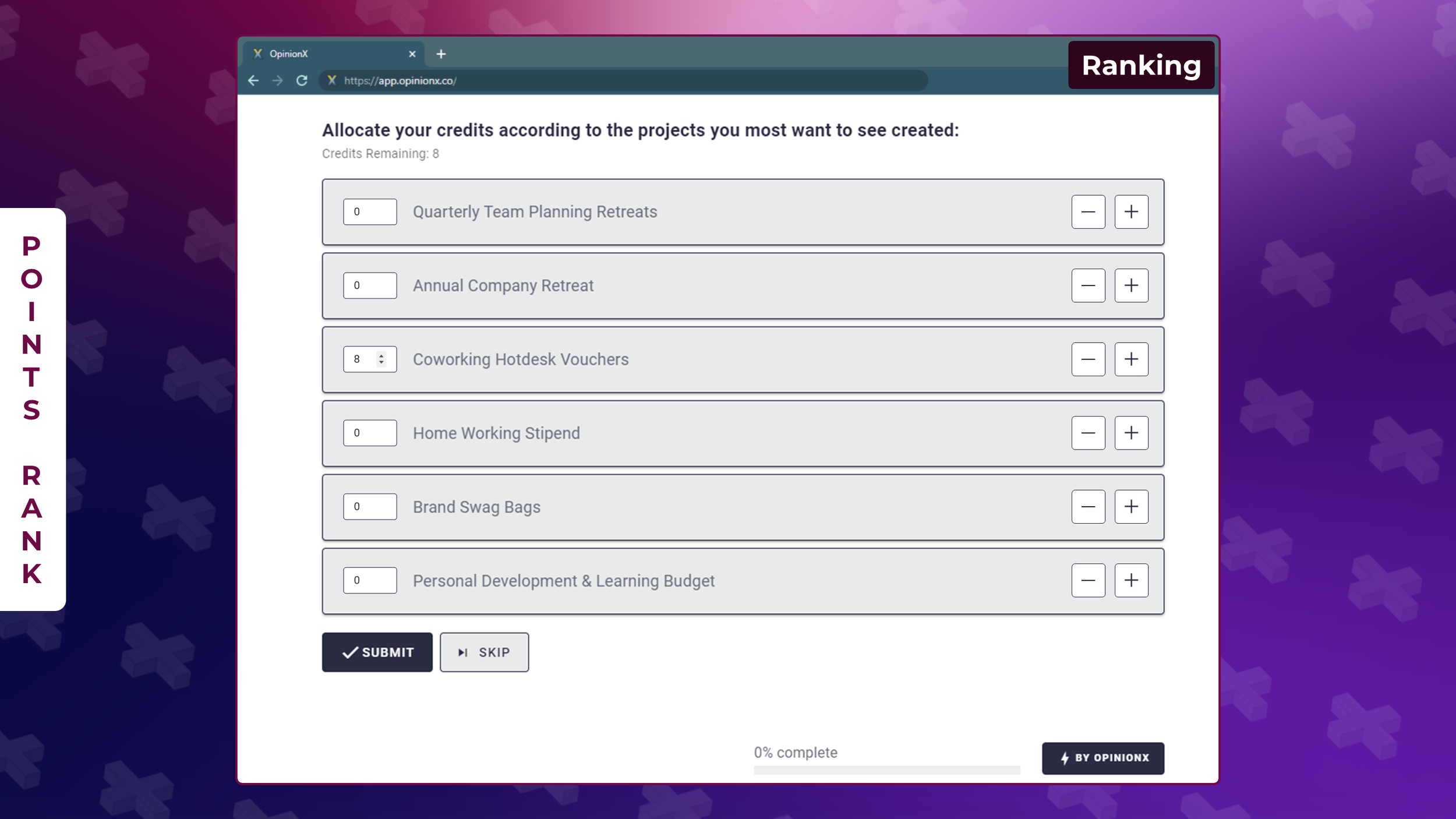
Every example screenshot in this post came from OpinionX, which is built specifically for ranking surveys. The question type is called Points Rank, and every ranking format is available on the free tier.

^ “Points Rank” is the name for Points Allocation questions on OpinionX
Free tier. Unlimited surveys, unlimited questions, unlimited ranking options and unlimited researcher seats, capped at 25 participants per survey. Every question type and every analysis feature is included, with no monthly or annual response limits, just the per-survey cap.
Paid. The Analyze plan is $900 a year and removes the participant cap. Billing is yearly, with no per-survey fees.
The analysis is designed around ranked data for the same reason. Segmentation recalculates results to show how different subgroups voted against the overall picture, and a contingency table is generated automatically for every question.
2. Mentimeter
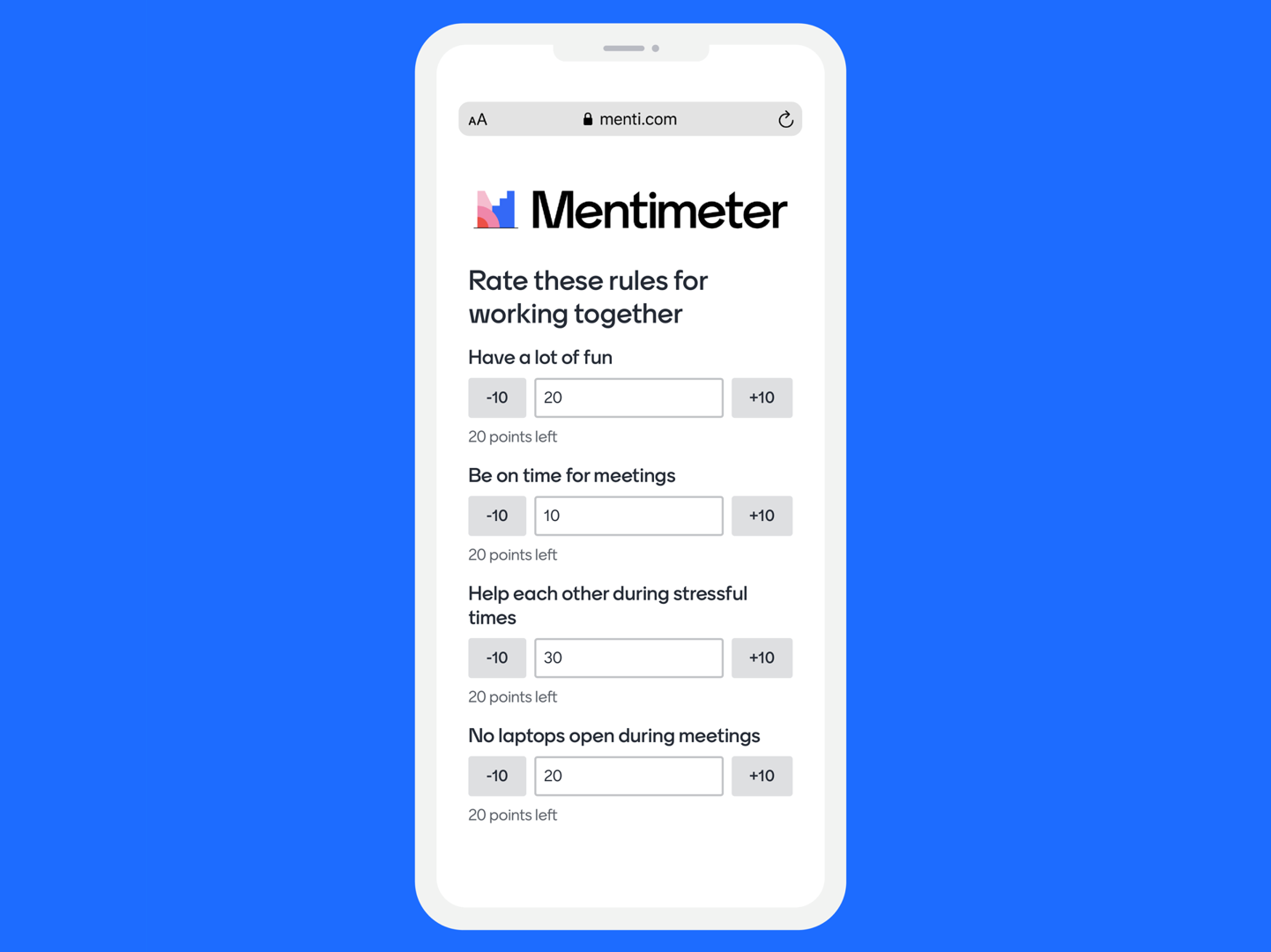
Mentimeter is an audience engagement tool built for classrooms. Its "100 Points" question gives participants 100 points to allocate, but only in bundles of 10, and neither the total nor the bundle size can be changed.
Verdict: workable for a live classroom or workshop, too rigid for research. The fixed bundles mean you can't capture anything finer than a 10% increment.
3. Polly
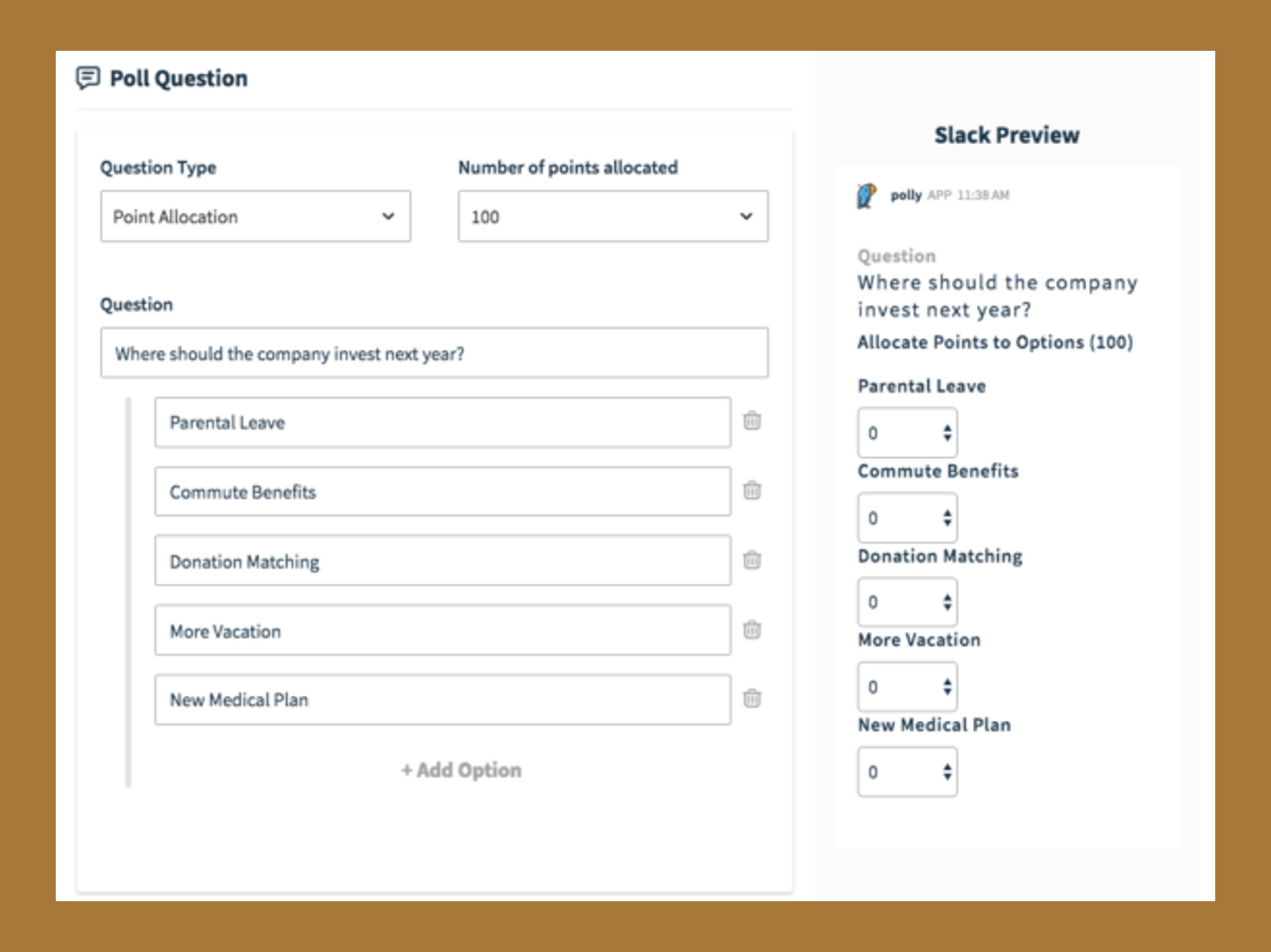
Polly runs polls inside Slack, Microsoft Teams and Zoom. It offers the format, limited to 10 options and a maximum budget of 100 points per participant.
Verdict: good if your participants already live in Slack and your list is short. The 10-option ceiling rules out most ranking work.
Frequently asked questions
What is a points allocation question?
A survey question that gives each participant a fixed budget of points to distribute across a list of options however they choose. The distribution shows both the order of their preferences and how strongly they hold each one.
What is the difference between points allocation and constant sum?
Nothing. They're two names for the same method. "Constant sum" is the older term used in market research literature, and "points allocation" is the plainer description of what participants actually do.
When should you use it instead of ranking?
When you need magnitude, not order. A ranking tells you chocolate came first and vanilla second. A points budget tells you chocolate took 9 points of 10 and vanilla took 1, which is a completely different finding.
How many options can it handle?
Fewer than a comparison method. Participants have to hold the whole list in mind while dividing a budget across it, so somewhere between 3 and 10 options is the practical range. Past that, use pairwise comparison or MaxDiff instead.
Which free survey tools have this question type?
OpinionX, Mentimeter and Polly. Google Forms, Microsoft Forms, Typeform, SurveyMonkey, Slido, SurveyKing and Jotform do not offer it at all.
Over 42,000 researchers and product people get one method breakdown like this each week in The Full-Stack Researcher.
You can have a points allocation survey running in under five minutes on OpinionX. No credit card required, and every question type and analysis feature is unlocked on the free tier, capped at 25 participants per survey.