
POINTS-BASED RANKING SURVEYS
Measure how much people care using a points-based ranking survey
Ranking surveys just tell you which things people like most. Points Ranking allows stronger opinions to shine through in your ranked results by letting people freely assign a pool of points based on their personal preferences.
No credit card required
Trusted by scaling startups, research agencies, and large enterprises alike


What is a Points-Based Ranking survey?
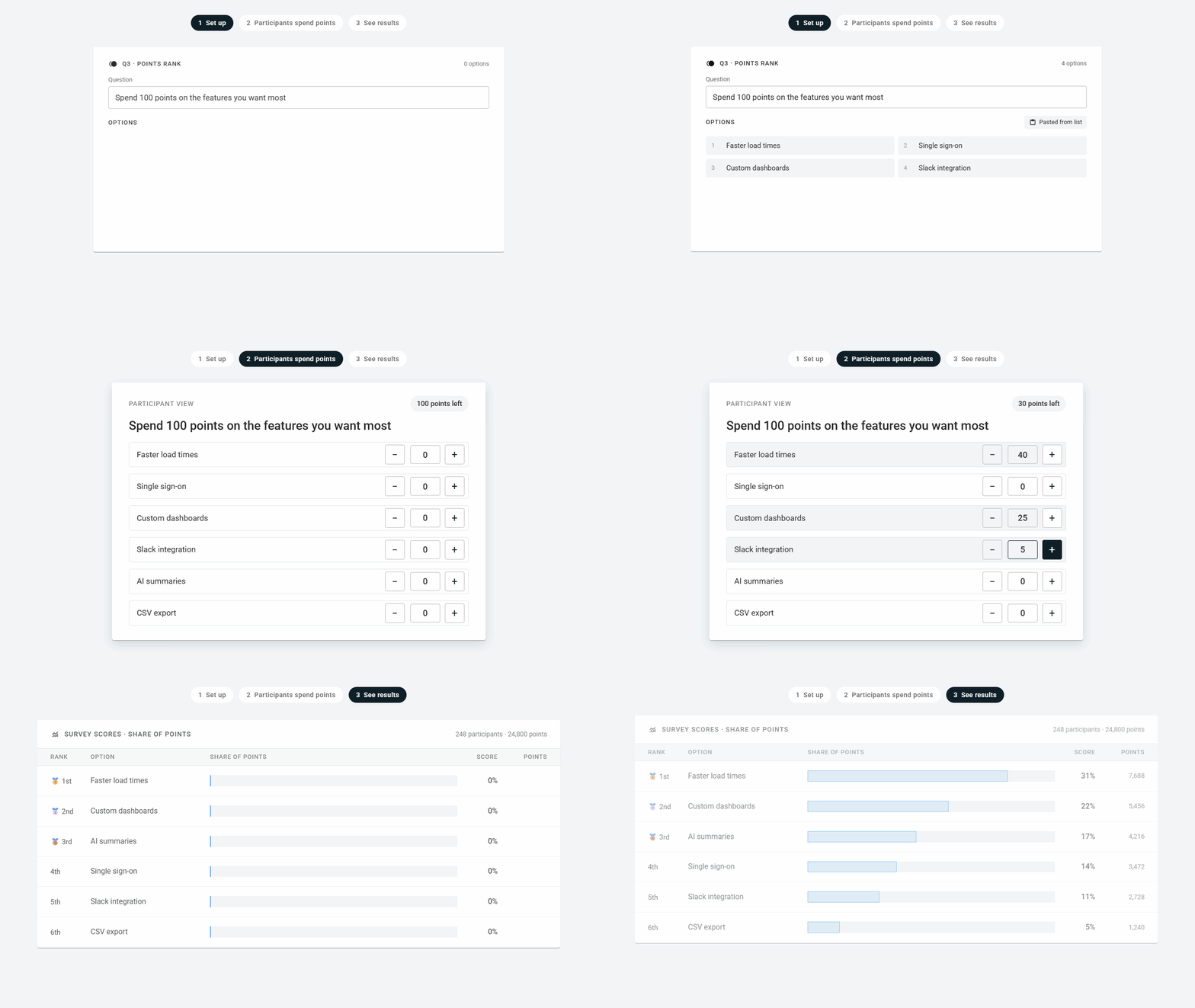
Points Ranking, also known as constant sum, is a survey where each participant receives a fixed budget of points to divide across a list of options based on their personal preferences. The results show both the order of their preferences and how strongly they prefer each one.
On OpinionX this method is called Points Rank. Each participant gets a budget, 10 points by default and adjustable to any number, and every option is scored by its share of all points allocated. It’s a simple yet powerful way to measure crowd consensus and people’s priorities at scale.
Use it when...
You need magnitude, not just order, on a short list of 3 to 10 options participants can weigh consciously: features in a plan, parts of a bundle.
Best for...
Pricing teams unbundling a package to see what each part is worth, product teams sizing feature value, and teams asking where a working week's hours go.
Alternative methods...
Pairwise comparison or MaxDiff are better suited for ranking longer lists of 10+ options.
Order Rank let's people drag-and-drop rank the full list, which is quick and easy.
How Points Rank works on OpinionX
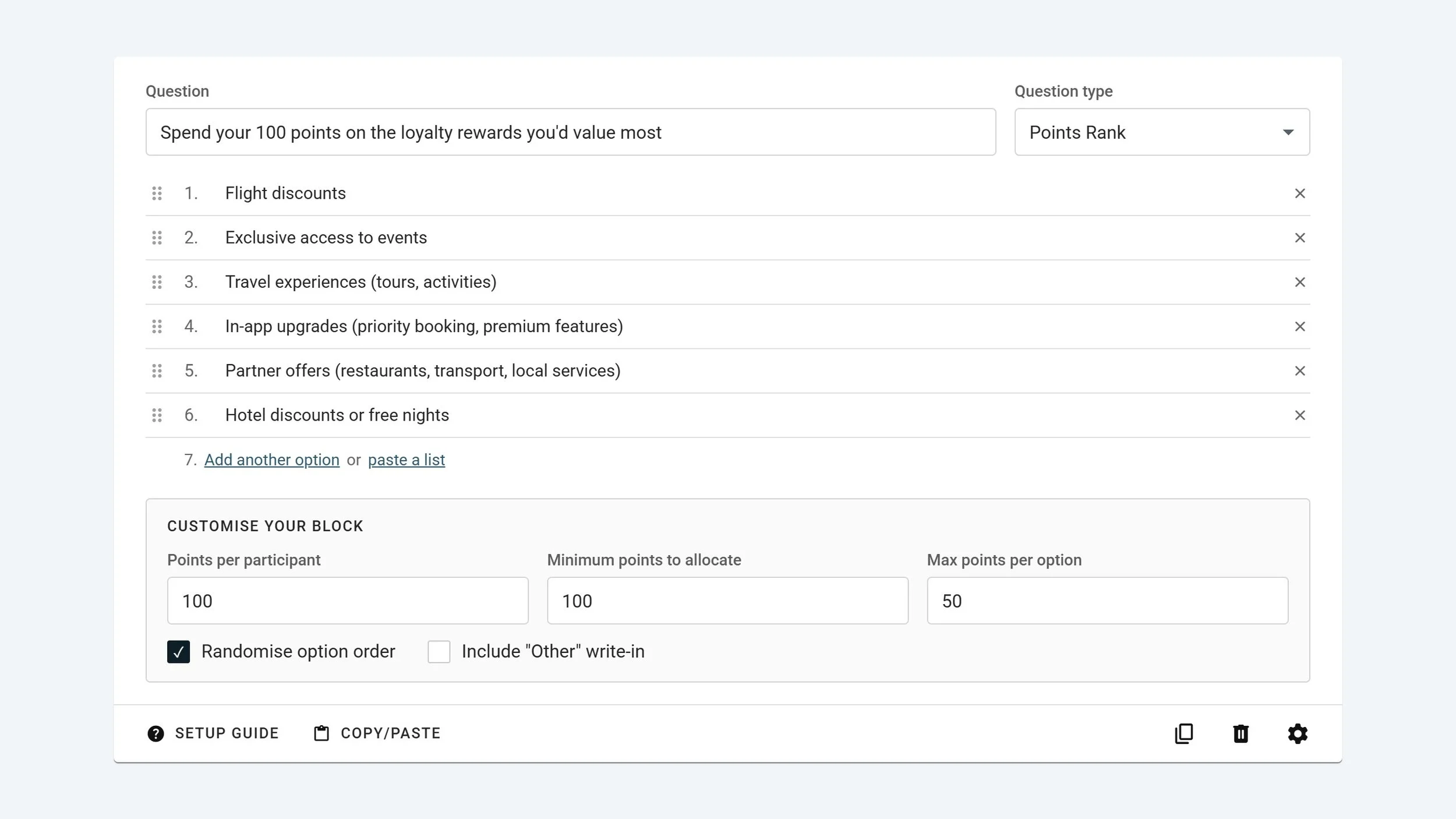
Quick and easy survey setup
Paste your list of options into OpinionX and set how many points each participant can spend. Choose from a range of customisations to ensure everything matches your requirements.
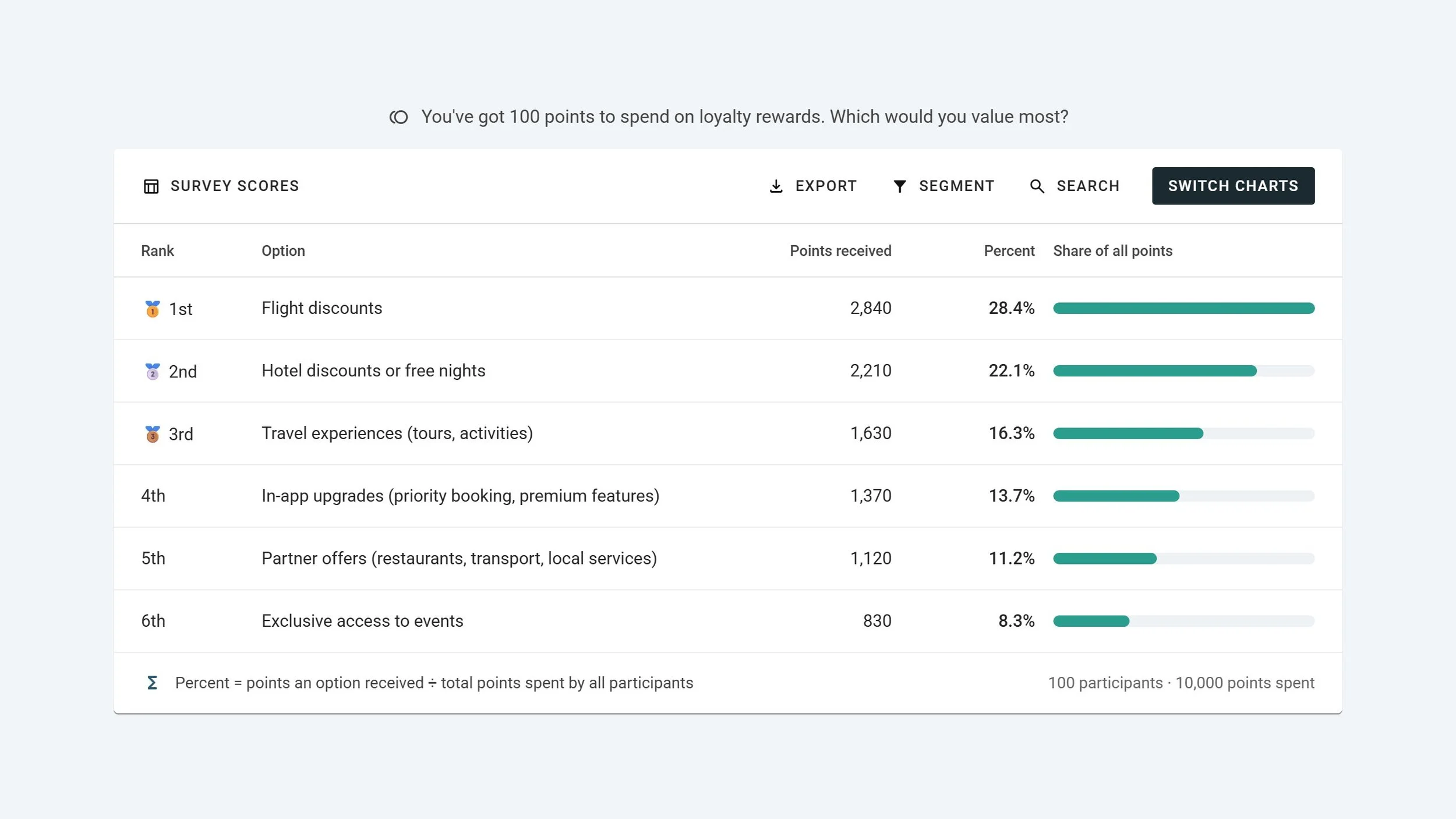
Understandable scoring you can stand behind
Points Rank on OpinionX uses a simple scoring formula: how many points did each option receive out of the total points spent by all participants.
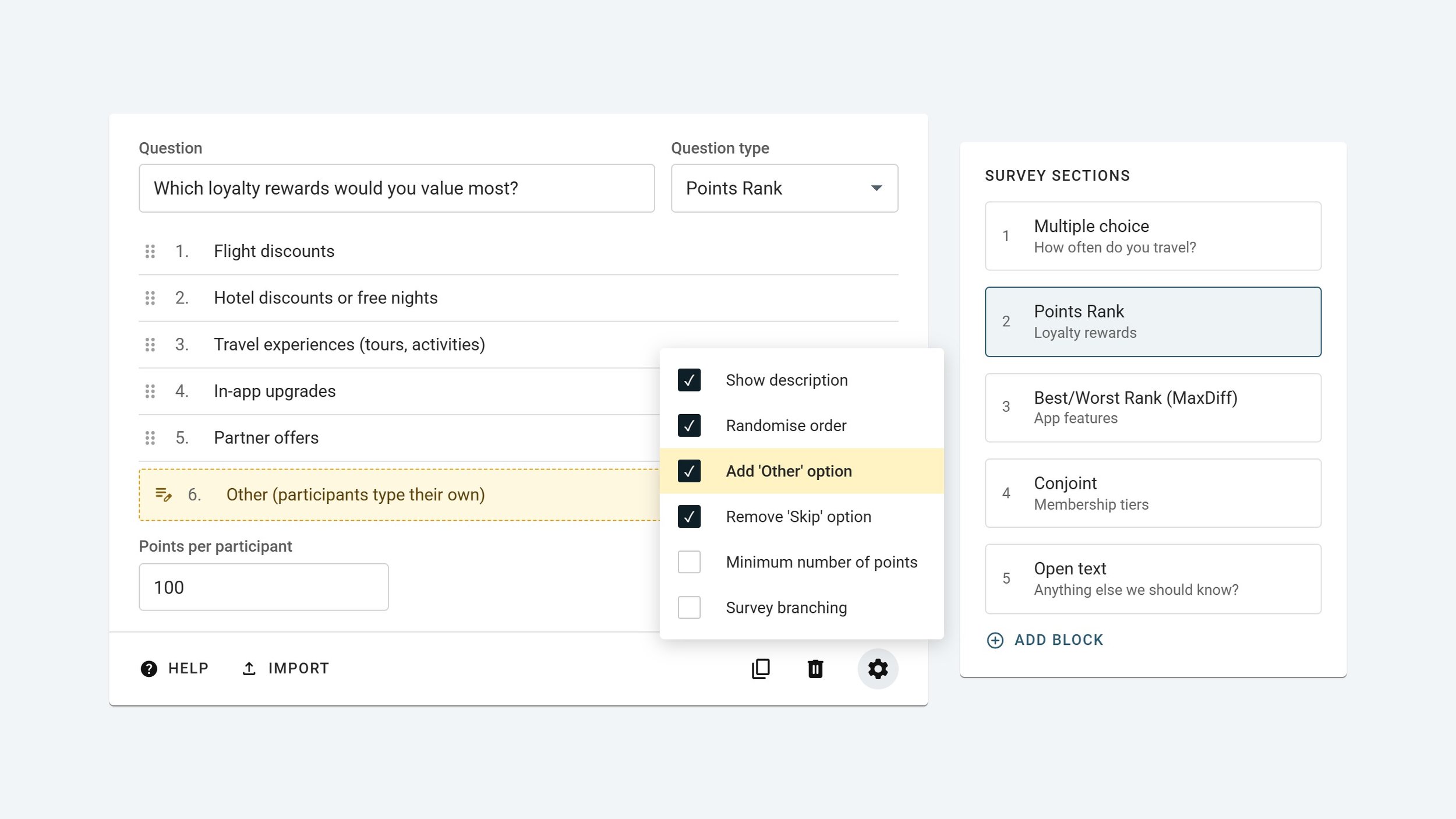
Full research flexibility without limitations
Include any other questions in your survey, including advanced methods like conjoint and maxdiff analysis. Allow a custom “other” option where participants can type and vote for their own choice.
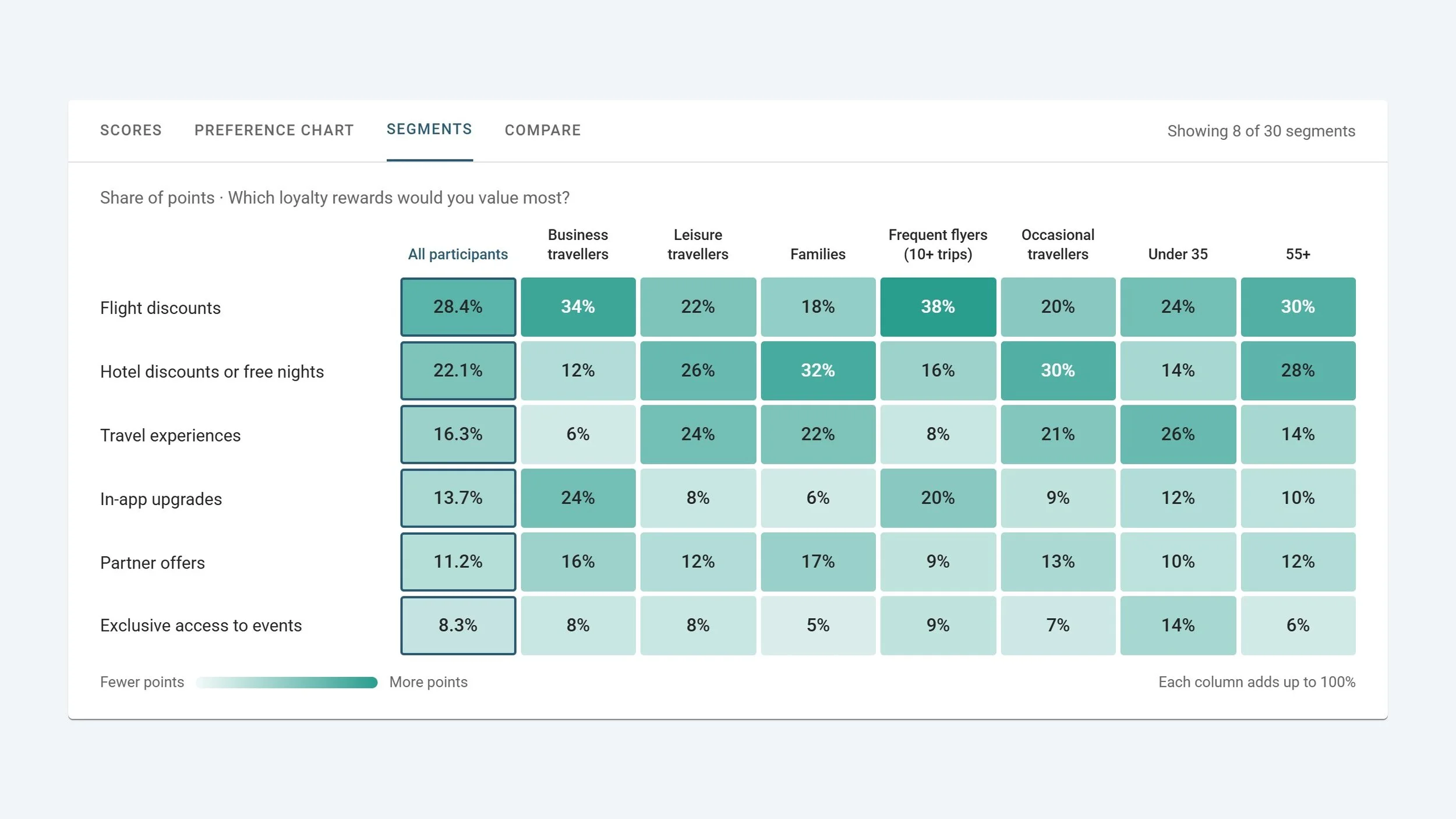
Filter by group to identify differences in opinion
Filter your results with one click, view two groups side by side, or create a giant table of up to 30 segments to quickly see the how different types of people voted.
Test a real Points Rank survey
Vote on the Points Rank sample survey below and view the interactive results dashboard at the end
All the results charts you need, generated automatically from your survey data
OpinionX turns everyone’s votes into an interactive results dashboard in real time, together with all the report types you need to answer your most important research questions.

Survey Scores
Every option ranked by its share of total points, with the raw points behind each score, exportable per participant.

Preference Chart
The same ranking as a bar chart, so a 40-point favourite and a 4-point afterthought look as different as they are.

Compare Tab
Two participant segments in two columns, so you can see whether paying customers fund the same feature that free users do.

Segments Tab
Point share for every option in every segment in one heatmap crosstab, the pattern and the exceptions visible in one scan.
Don’t settle for another basic voting poll
Measure how much people really care using an engaging points-based ranking survey
Points-based ranking is available on every plan
✓ 25 participants per survey
✓ Unlimited surveys
✓ Unlimited researcher seats
✓ Full analysis & exports
✓ Unlimited participants per survey
✓ Unlimited researcher seats
✓ Advanced analysis & data enrichment
✓ Custom exports
✓ SAML SSO & MFA
✓ Private team folders
✓ White-labelling
✓ Procurement & prepaid experts
Watch: Creating a ranking survey in under 60 seconds
Points Rank FAQs
-
Nothing. They are two names for the same method. Constant sum is the older market research term, describing a budget that always adds to the same total. Points allocation describes what participants do. OpinionX calls the block Points Rank and uses both terms in its guides.
-
When the size of the gap changes the decision. A plain ranking only tells you the order; a points budget tells you whether the winner took 9 of 10 points or barely edged the rest at 4. Use it for explicit trade-offs participants can reason through; for gut-level preference, pairwise comparison reads it better.
-
No. You have the flexibility as the researcher on OpinionX to choose a minimum and maximum number of votes that must be spent. You can leave the minimum empty if you want to let participants only spend the points relevant to them.
Measure people’s preferences with Points Ranking
Let people spend their points to reveal what they actually care about most from your list