
ADVANCED SURVEY PLATFORM
Rank people’s preferences and priorities with a toolkit of purpose-built survey methods
Researchers don’t use rating scales to measure relative importance; they choose voting methods that build-in trade-offs and force people to make choices. OpinionX is a research platform purpose-built for trade-off surveys.
No credit card required
Trusted by scaling startups, research agencies, and large enterprises alike


What is a trade-off survey method?
Unlike a list of rating scale questions where respondents can give everything the same score, a trade-off survey method forces participants to compare multiple options and choose what is more important to them. These methods are popular ways to measure relative importance, quantify people’s priorities, and power group decision-making.
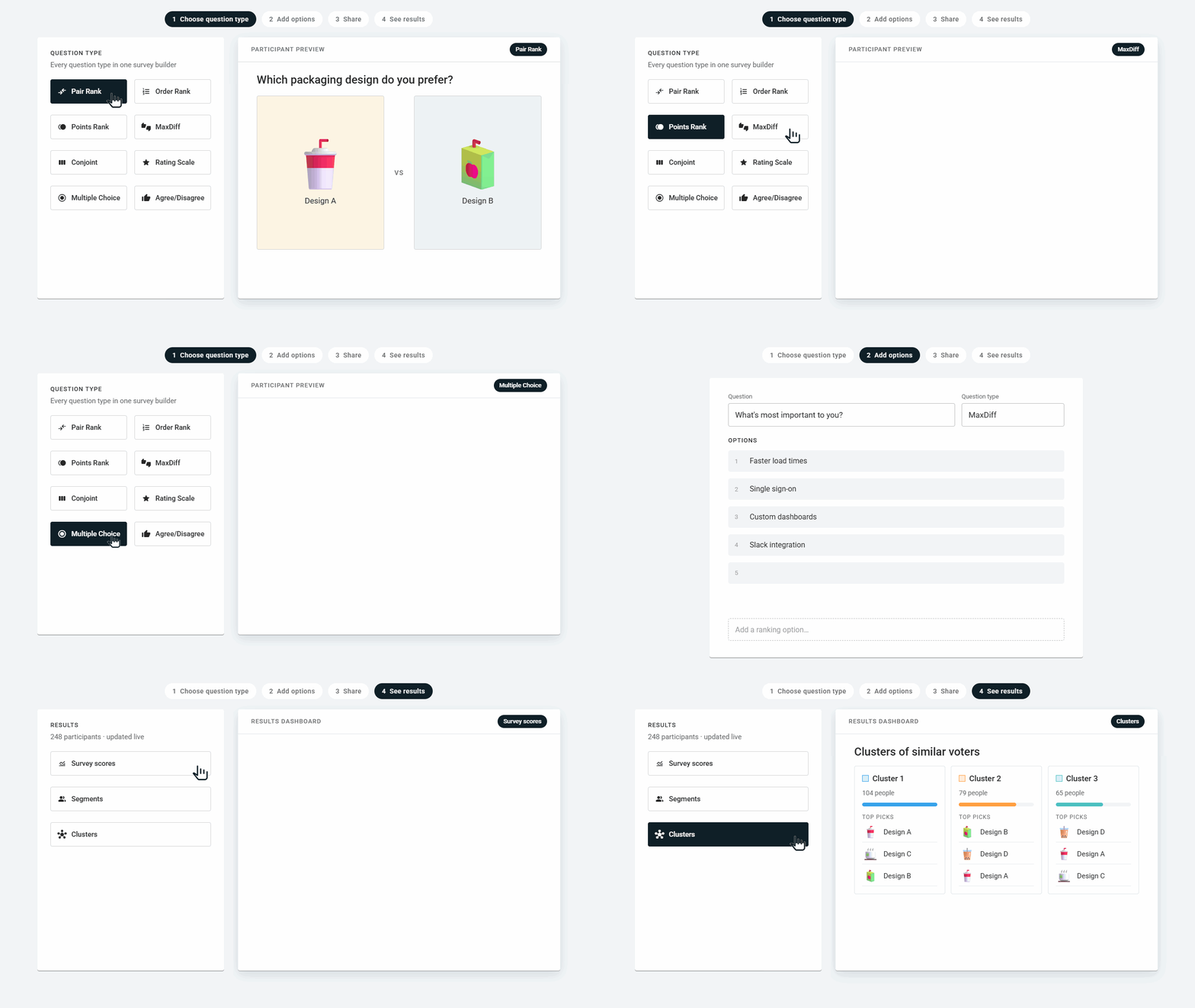
OpinionX offers a toolkit of survey methods that specialise in trade-off voting. Pick between simple drag-and-drop Order Rank surveys, head-to-head Pair Rank voting, or advanced market research methods like Conjoint Analysis. Every method works as a block you can mix and match in OpinionX’s flexible survey builder.
Use it when...
A rating scale gave you a wall of 7s and nothing separated. You need a ranked answer you can actually build, segment or price against.
Best for...
Product managers and UX researchers running roadmap, segmentation and pricing studies in-house, without a specialist licence or an agency, on participants they already reach every week.
Learn more...
Watch this video tutorial showing you how to create a ranking survey in under a minute. Read the dedicated guides for each survey method. Pick the right survey method in four simple steps.
OpinionX’s toolkit for ranking research
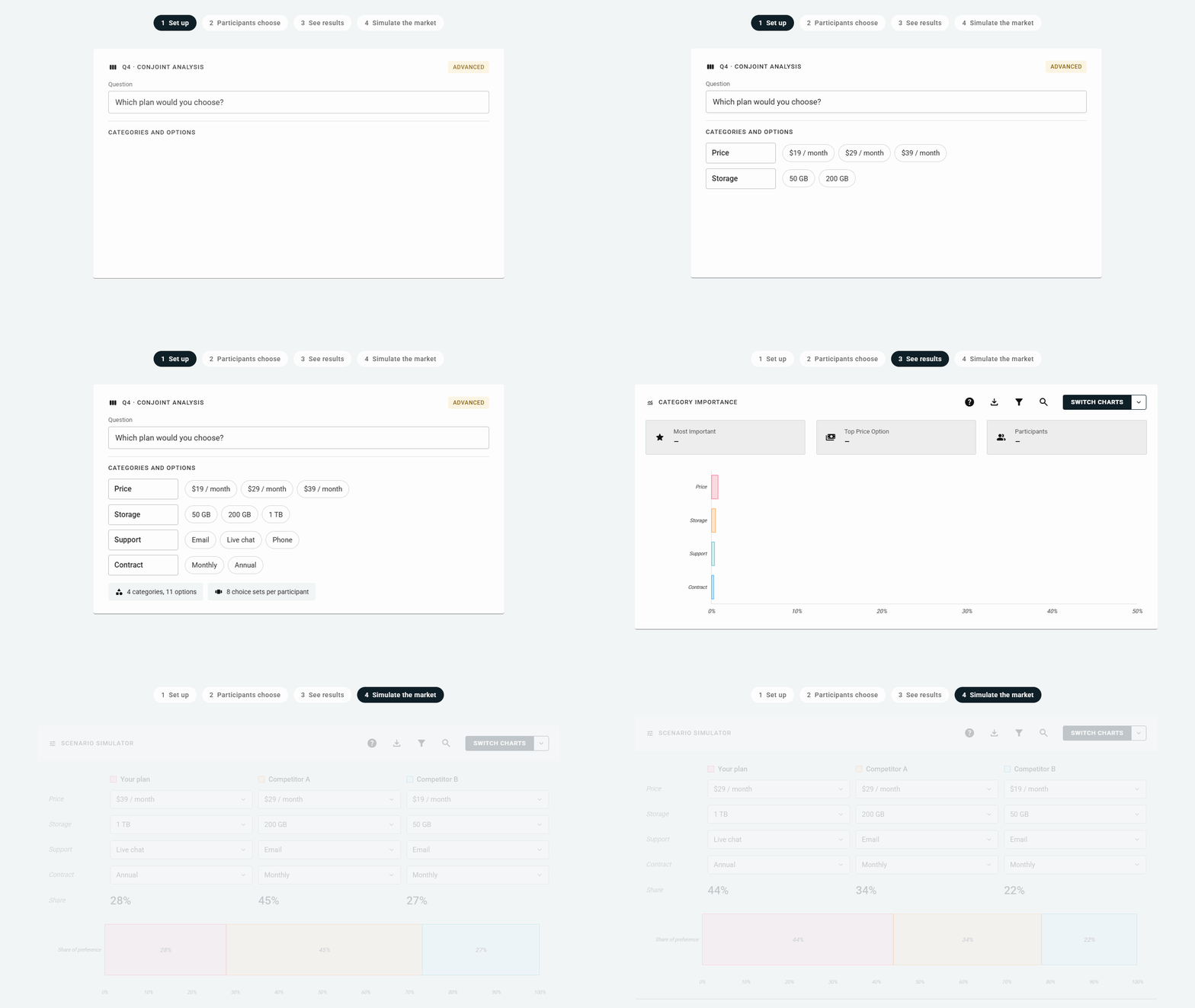
Conjoint Analysis
Participants choose between profiles of attributes with randomised options. Automated scoring tells you which attributes matter most, and which options are most popular within each attribute.
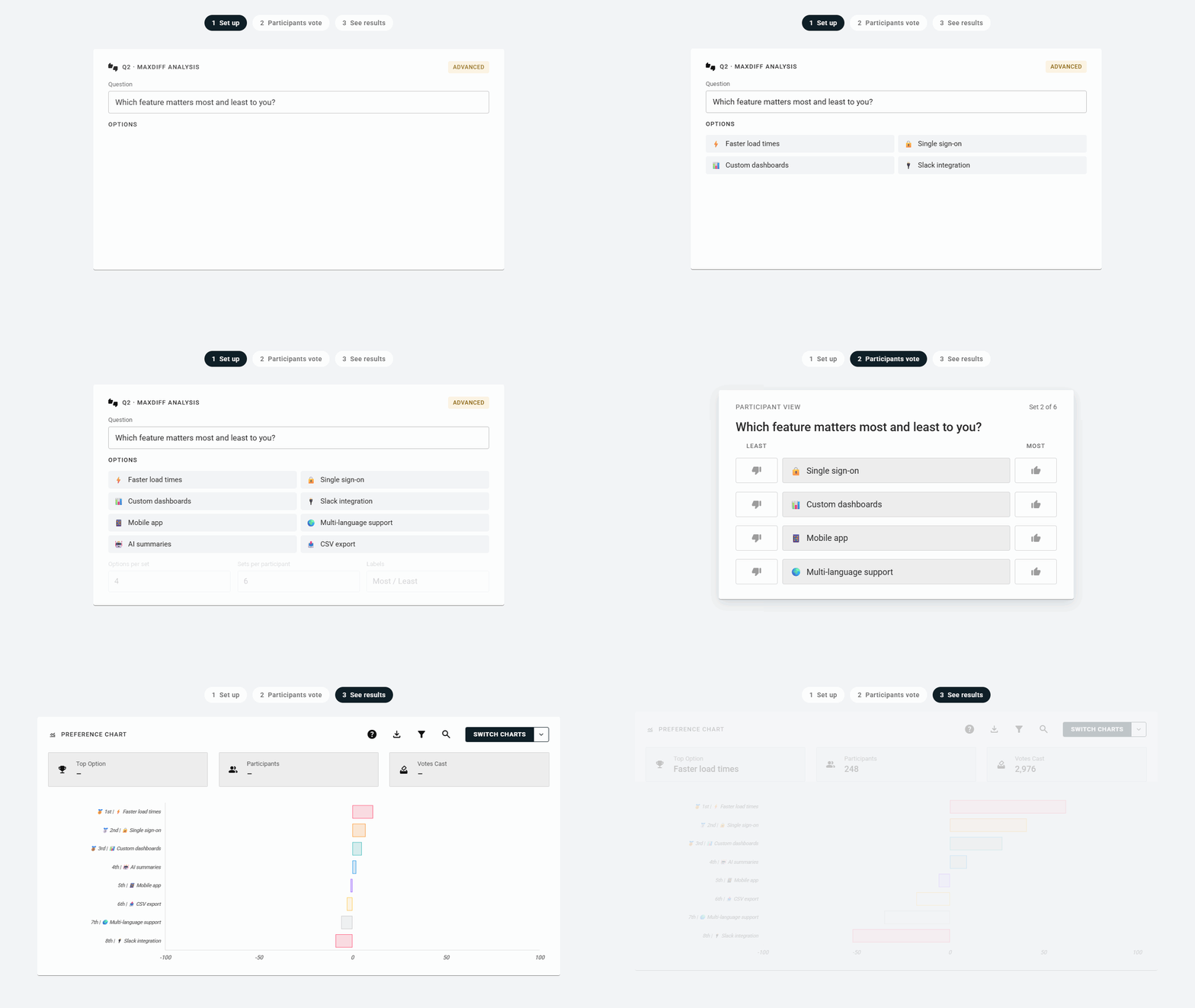
MaxDiff Analysis
Participants pick the best and worst option each time from sets of 3-6 options. Their votes automatically score and rank the entire list. Customise the labels to match your use case.
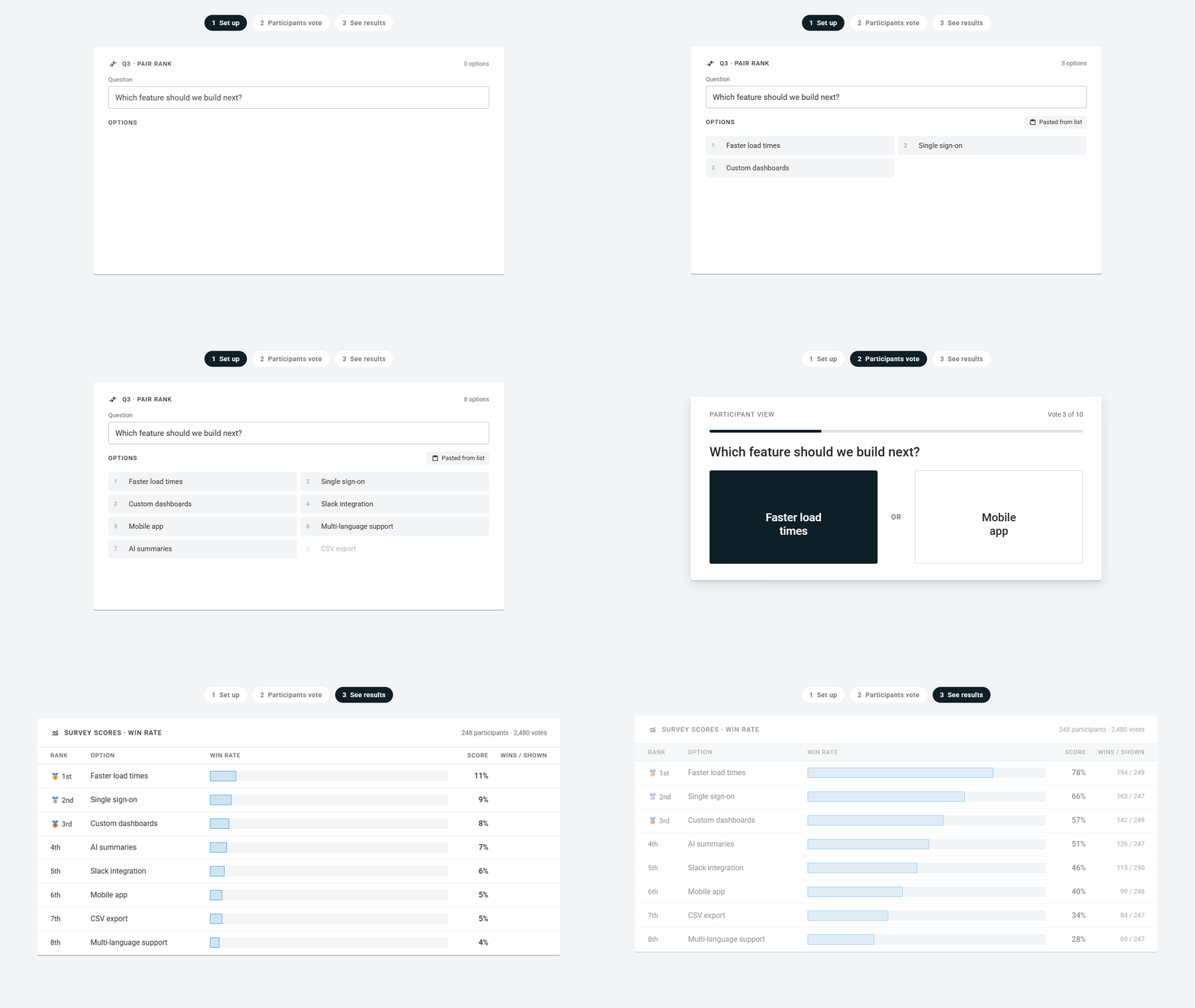
Pairwise Comparison
Participants rank a long list of options by voting on a series of randomised head-to-head pair votes. Each option gets a score based on how often it is chosen as the winner, resulting in simple yet powerful results.
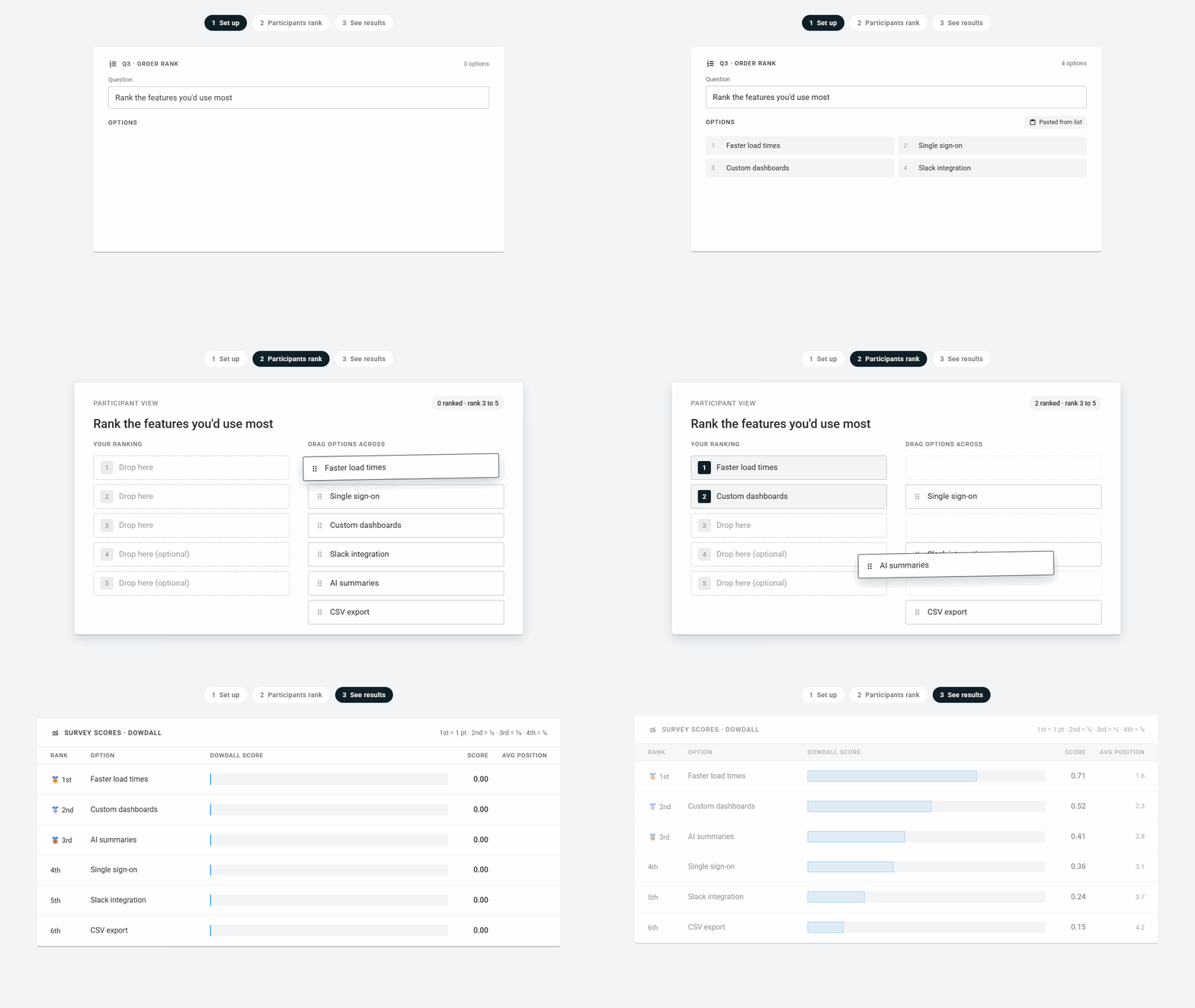
Ranked Choice Voting
Participants drag a list of options into order of preference, importance, or priority. With a special scoring model that allows for excluding irrelevant options and flexible minimum or maximum rules.
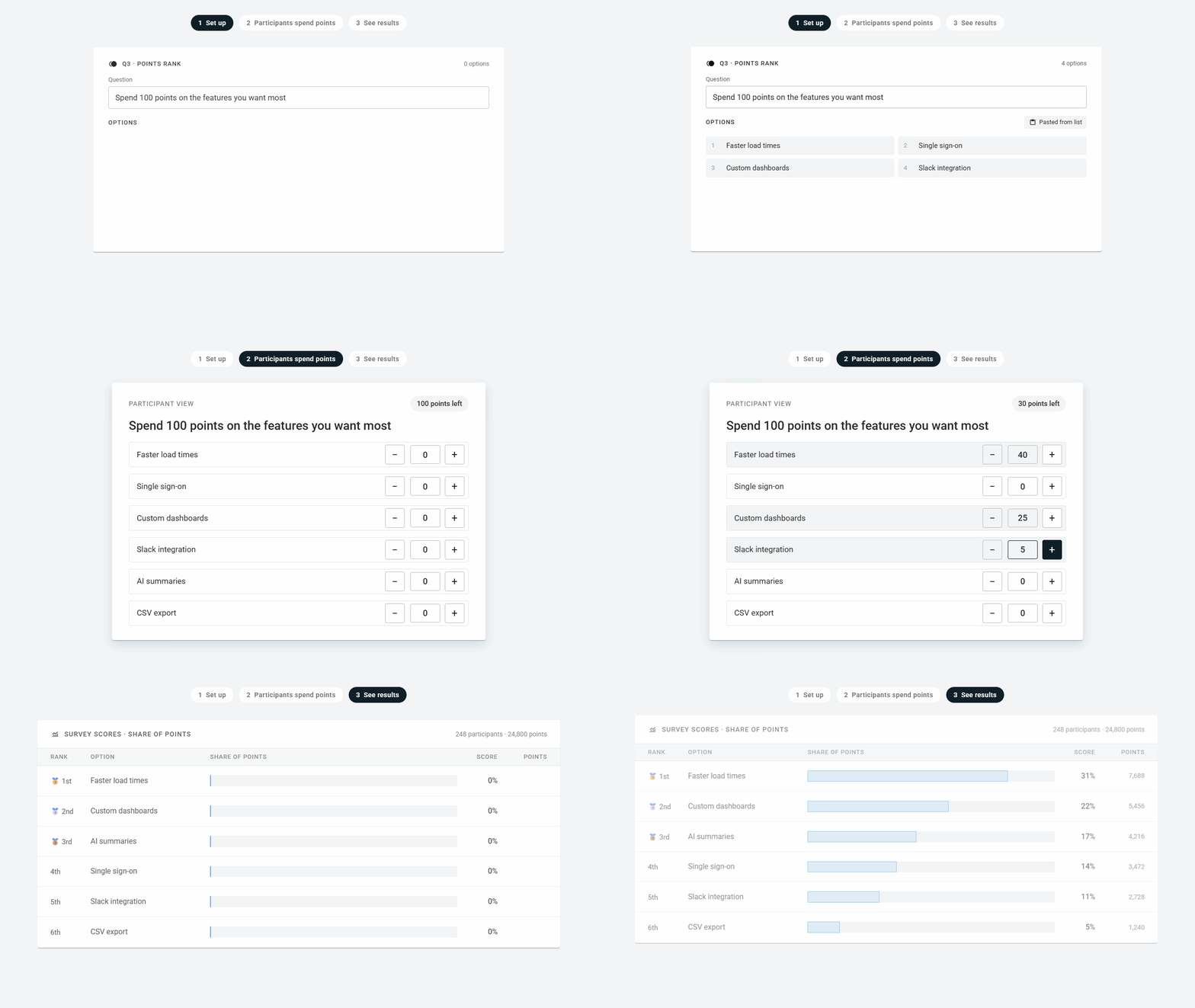
Points-Based Ranking
Participants are given a budget of points to spend freely across a list of options. Allows people to show how much different options matter to them based on how they spend their points.
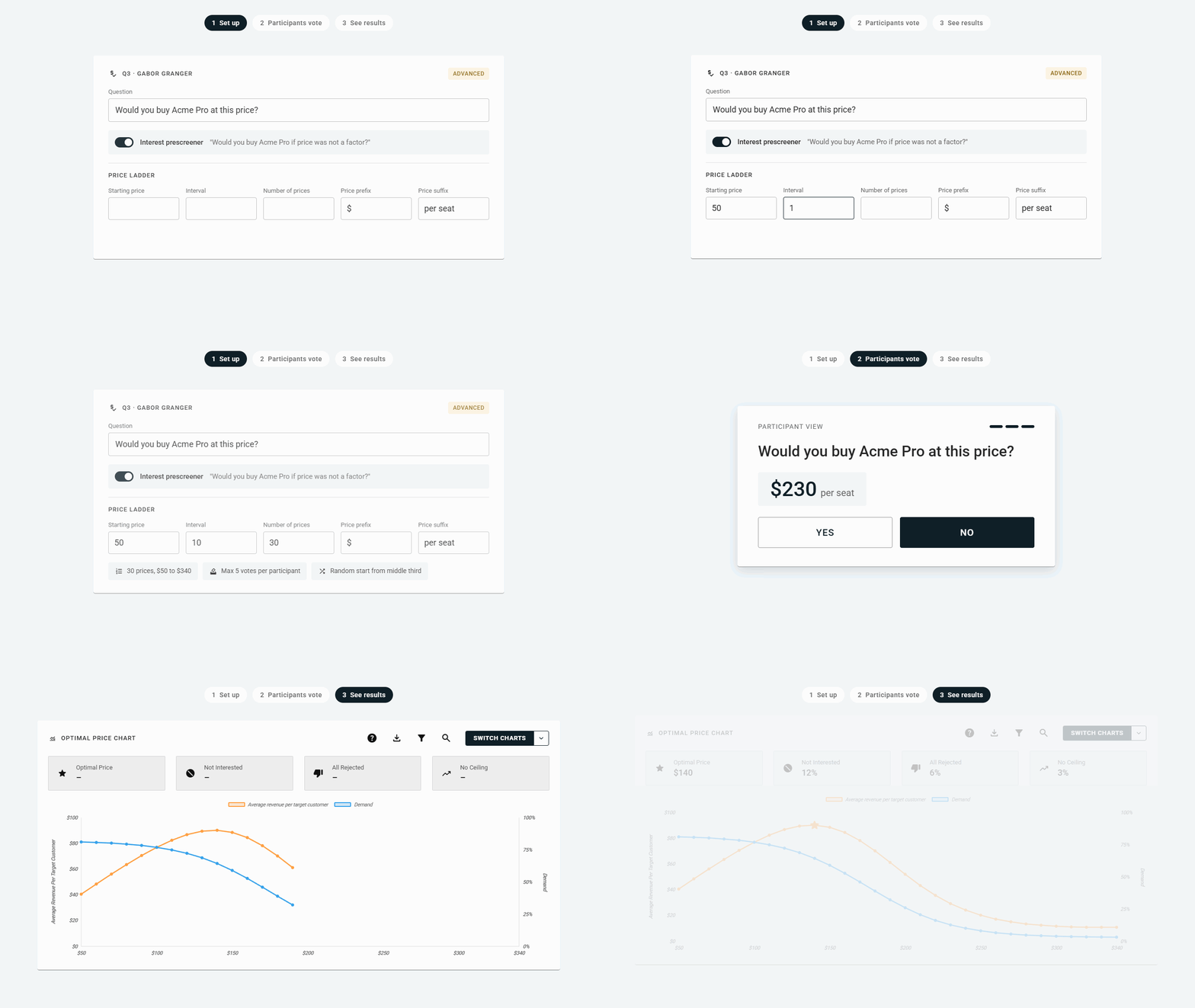
Gabor Granger
Participants are asked if they would buy a product, service or feature at a series of prices. Each new price adjusts based on their yes/no voting, and results automatically calculate a revenue-maximising price.
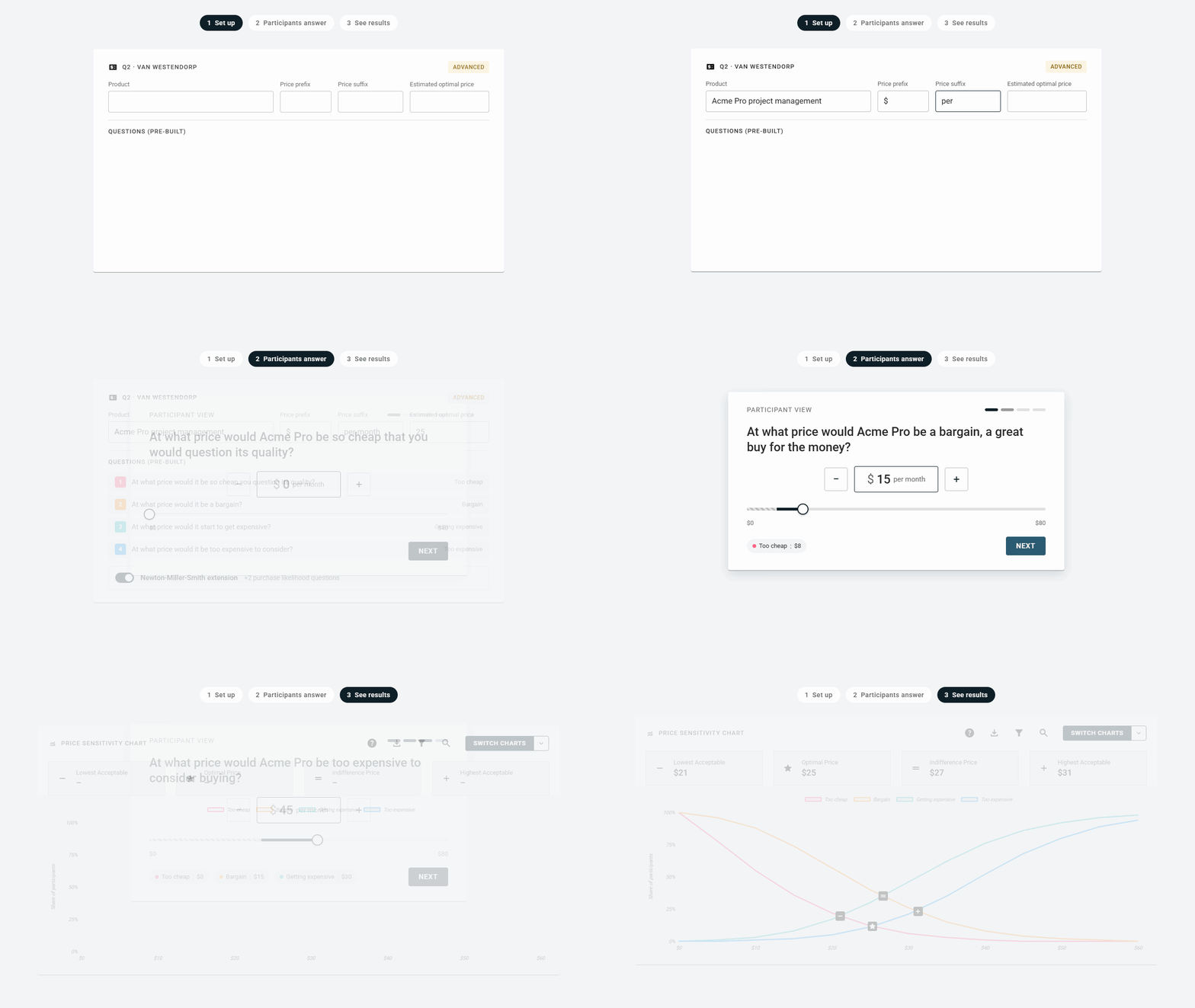
Van Westendorp
Calculate an optimal price range for a new product by asking people to suggest prices for when it would be too cheap, acceptably cheap, acceptably expensive, and too expensive. One of the world’s most popular pricing research methods, fully automated.
Every OpinionX survey method is compatible with image ranking →
All the features you need, with results generated automatically from participant votes
OpinionX turns everyone’s votes into an interactive results dashboard in real time, together with all the report types you need to answer your most important research questions.
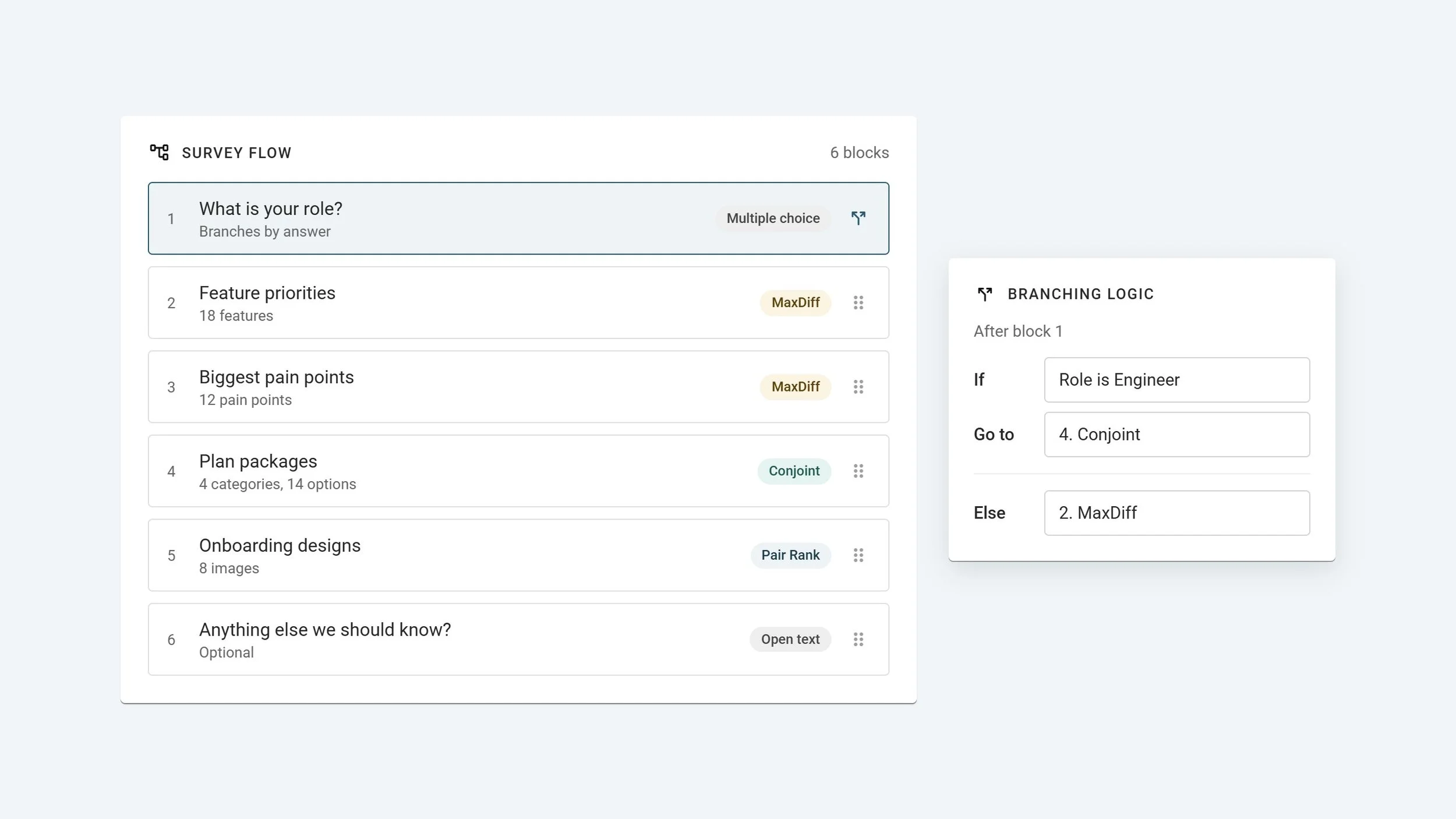
Combine several methods in one survey
Full flexibility to mix and match any methods in a single survey. Combine MaxDiff and Conjoint Analysis, put multiple blocks of the same method together, and use branching logic to create custom flows.
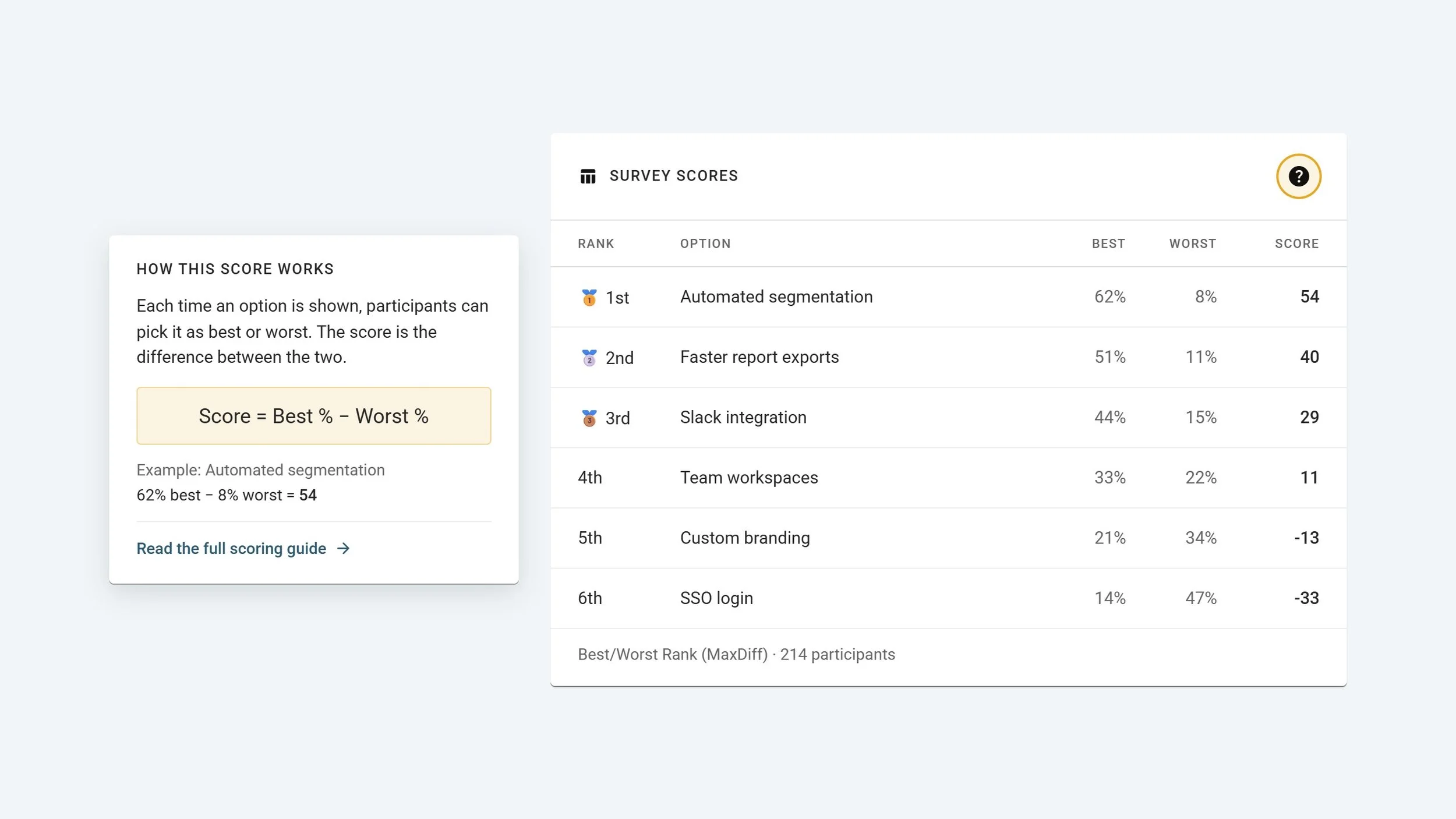
Transparent scoring you can stand behind confidently
Every method has a transparent guide explaining how scoring works, because we know that research is only ever as strong as it is trusted by you and your team.
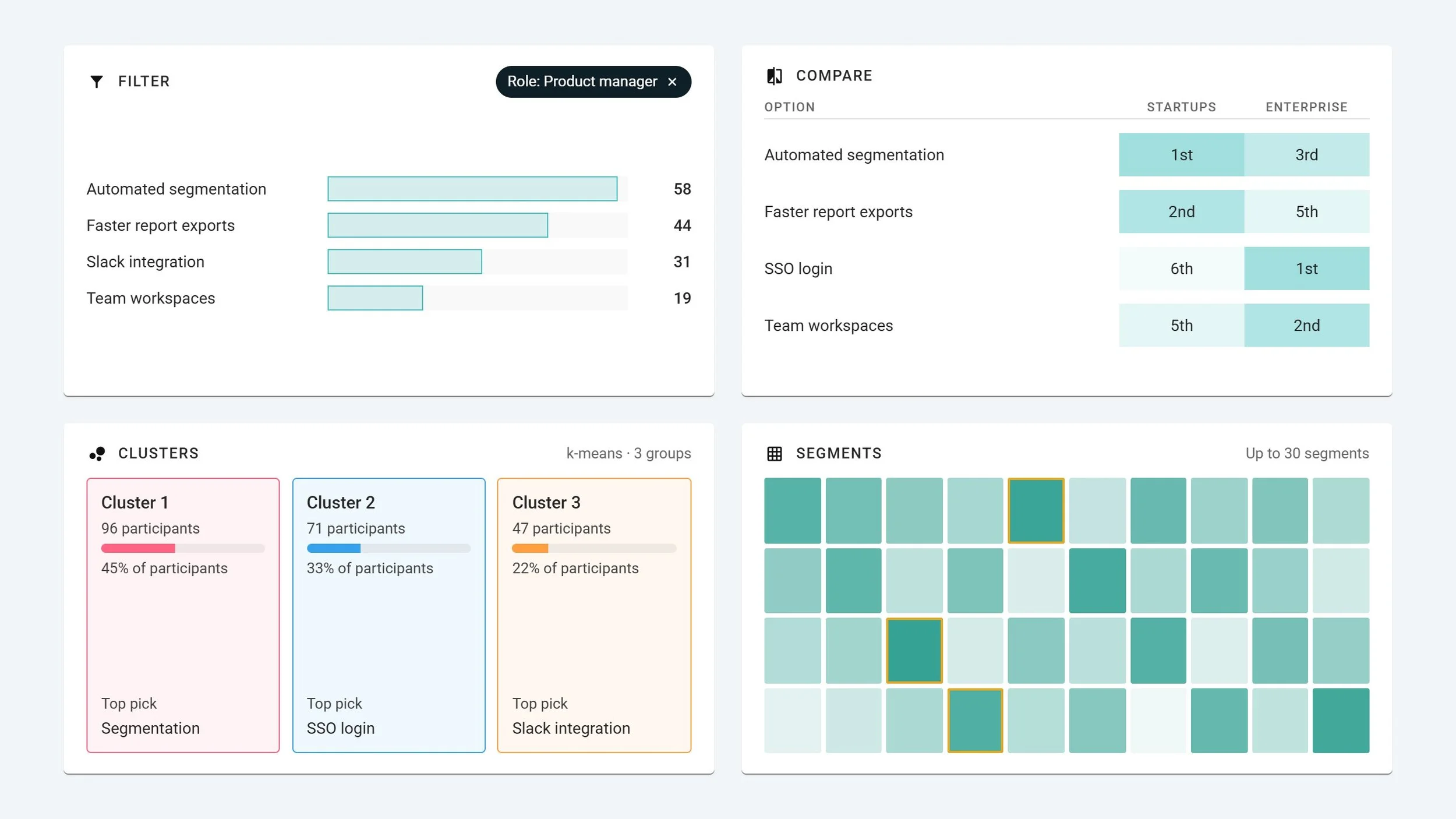
Filter and compare results by group
Filter your results with one click, view two groups side by side, run clustering analysis to group similar voters together, or create a giant table of up to 30 segments to spot types of people who voted most differently.
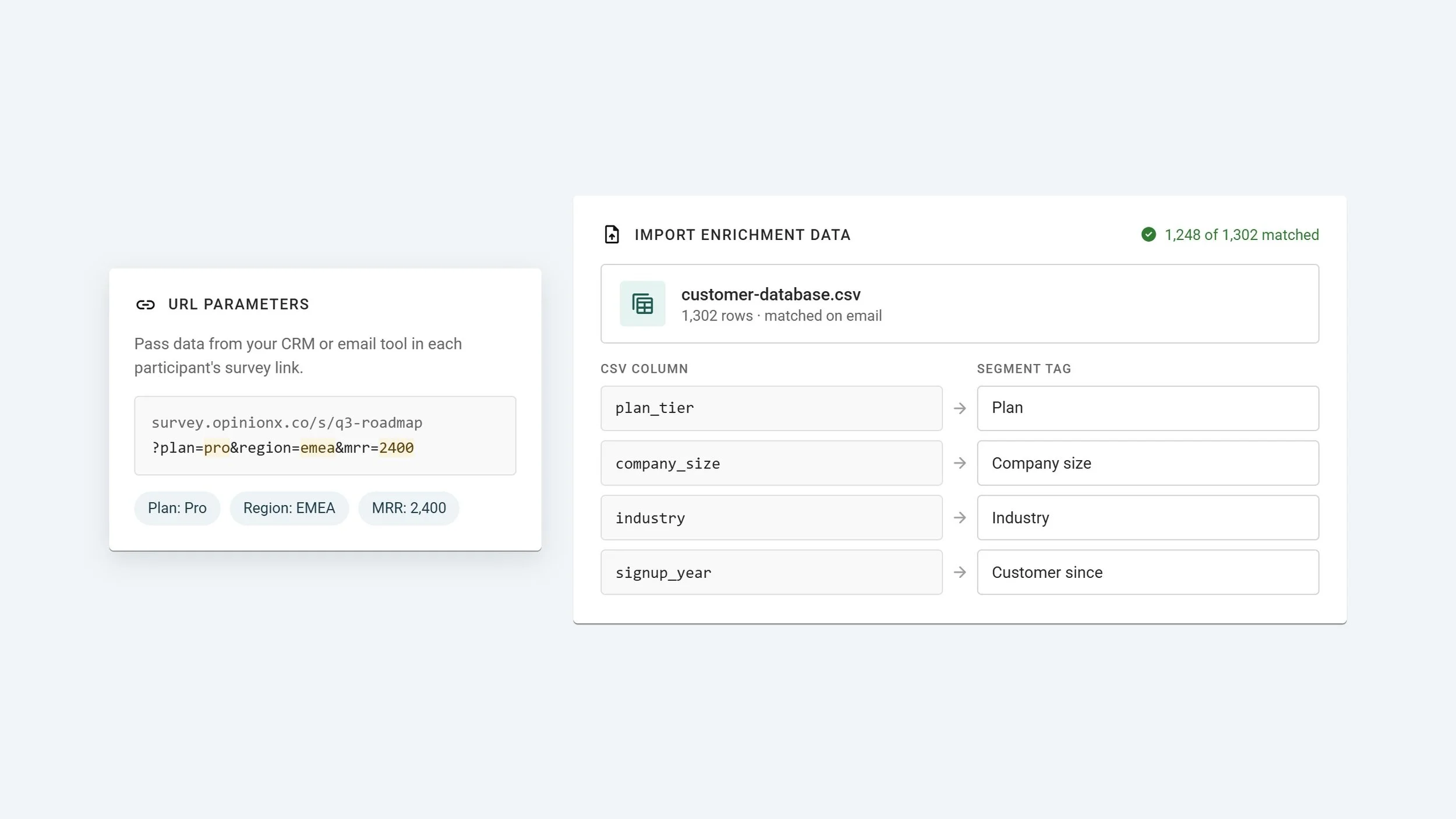
Enrich analysis with your existing data
Keep your surveys shorter by integrating existing data you can use later on during analysis. Import an enrichment dataset or dynamically pull information from a third-party source using URL parameters.
Not sure which method to use?
Describe the decision you're trying to make and receive a recommended method and survey structure to use.
Every method is available on the free tier
✓ 25 participants per survey
✓ Unlimited surveys
✓ Unlimited researcher seats
✓ Full analysis & exports
✓ Unlimited participants per survey
✓ Unlimited researcher seats
✓ Advanced analysis & data enrichment
✓ Custom exports
✓ SAML SSO & MFA
✓ Private team folders
✓ White-labelling
✓ Procurement & prepaid experts
Watch: Creating a ranking survey in under 60 seconds
Guides for running trade-off research
Trade-Off Surveys FAQ
-
On a rating scale, every option can score high at once, so ten features land between 7 and 9 and you learn nothing about which one wins. A trade-off makes participants choose between them, and the ranked result shows the disagreement the average was hiding.
-
Match it to your options list and the decision you’ll use it to make. Under 10 known options: rank order. A long list of short labels: MaxDiff. Long statements: pairwise comparison. Magnitude, not just order: constant sum. Options that are attributes of one product: conjoint. Price alone: Van Westendorp or Gabor Granger.
-
Yes. Every method is a block, so one survey can screen participants, run a MaxDiff on features, a conjoint on packaging and a pricing question, then report all of it on one results page with one set of segments. Branching routes each participant to the blocks that apply.
Advanced ranking research, available for free
Every survey method is available on our free tier. Get started in minutes.